
Manufacturer: Lasair® III Particle Counter
Portable airborne particle counter for cleanroom monitoring using laser-based detection. Provides real-time particle size distribution, data logging, and compliance with ISO/GMP standards.
Location: SE1 154 (cleanroom)
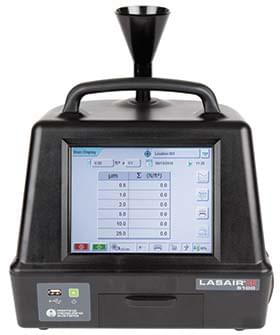
This tool is used to monitor particulate count in Class 100 and Class 1000 cleanrooms.
Particle Counter — Lasair® III Airborne Particle Counter
The Lasair® III Particle Counter is a portable airborne particle monitoring system used to measure and classify particle contamination levels in cleanroom environments. It supports ISO 14644 and GMP compliance monitoring with real-time data acquisition and reporting.
Key Features
- Multi-channel particle size detection (simultaneous size bins)
- Portable or standalone operation with internal battery
- Touchscreen interface for control and data visualization
- Built-in data logging, storage, and reporting
- Ethernet, USB, and serial communication for data transfer
- Compatible with cleanroom standards (ISO, GMP, FS-209E)
Operating Principle
- Air is drawn into the system at a controlled flow rate
- Particles pass through a laser optical detection chamber
- Scattered light intensity is measured to determine particle size and count
- Data is categorized into size channels and displayed in real time
Operation Workflow
- Connect sampling probe and power on the system
- Configure sampling parameters (location, volume, duration)
- Start sampling via touchscreen interface
- Monitor real-time particle counts and trends
- Store, export, or analyze collected data
Applications
- Cleanroom classification and certification
- Environmental monitoring (ISO 14644 compliance)
- Process validation and contamination control
- Research and nanofabrication facility monitoring
Training and Usage
Users are trained on:
- Instrument setup and sampling configuration
- Data interpretation and reporting
- Routine maintenance and calibration awareness
Detailed Safety Considerations – Particle Counter System (Lasair® III Airborne Particle Counter)
The particle counter system involves minimal physical hazard but requires attention to electrical safety, laser-based detection, cleanroom protocol, and contamination control. Improper use can result in data inaccuracy, contamination of cleanroom environments, or equipment damage. Only trained and authorized users may operate the system.
Laser and Optical Safety
- The system uses a laser-based optical detection chamber to measure particle size and count.
- Do not open or access the internal optical chamber
- Avoid direct exposure to internal laser components
- Do not operate the system with damaged or open housing
- Only trained personnel may service internal optical components
Electrical Safety
- The system operates using internal electronics and rechargeable battery/power supply.
- Do not use the system with damaged power cords or connectors
- Ensure proper grounding when connected to external power
- Avoid exposure to liquids near electrical components
- Turn off system before connecting or disconnecting cables
Airflow and Sampling Safety
- The system actively draws air through a sampling probe.
- Ensure sampling probe and tubing are clean before use
- Do not block or obstruct airflow during operation
- Avoid sampling near loose debris or liquids
- Use proper sampling locations to prevent contamination or inaccurate readings
Cleanroom Contamination Control
- The instrument must be handled carefully to maintain cleanroom integrity.
- Ensure outer surfaces of the instrument are clean before entering cleanroom
- Do not place the unit on contaminated surfaces
- Use only approved cleanroom-compatible accessories
- Avoid introducing external contaminants through tubing or probes
- Clean sampling probe before and after use
Mechanical and Handling Safety
- The unit is portable and may be moved between locations.
- Handle the instrument carefully to avoid drops or impacts
- Secure the unit during operation to prevent movement
- Avoid placing the unit near edges or unstable surfaces
- Use proper lifting technique when transporting
Data Integrity and Operational Safety
- Incorrect setup can lead to invalid cleanroom certification data.
- Verify sampling parameters (location, volume, duration) before starting
- Ensure correct particle size channels are selected
- Avoid interrupting sampling once started
- Confirm calibration status before critical measurements
Battery and Power Safety
- The system may operate on internal battery or external power.
- Do not use damaged or leaking batteries
- Charge only with approved power adapters
- Avoid overcharging or improper storage
- Turn off unit when not in use
PPE Requirements
- Cleanroom garments (as required for the area)
- Gloves when handling instrument and sampling probe
- Safety glasses (recommended)
Operational Safety Checks (Pre-Run)
- Instrument exterior is clean and contamination-free
- Sampling probe and tubing are clean and properly connected
- Battery level or power connection is adequate
- Sampling parameters are correctly configured
- Instrument calibration status is valid
- Location is appropriate for measurement
Post-Operation Safety
- Stop sampling and save data
- Remove and clean sampling probe
- Power down the instrument
- Store instrument in designated clean area
- Export and back up data as required
- Log usage and report any abnormalities
Waste Handling and Contamination Control
- Dispose of wipes or cleaning materials in designated containers
- Do not introduce contaminants into cleanroom during transport
- Maintain cleanliness of instrument surfaces and accessories
Emergency Procedures
- Electrical fault → power down system and report
- Instrument malfunction → stop operation and notify staff
- Contamination incident → follow cleanroom protocol
- Data inconsistency → halt measurement and verify setup
- Do not resume operation until the system has been inspected and cleared.
General Cleanroom Conduct
- Use only approved procedures for cleanroom monitoring
- Maintain cleanliness of instrument and accessories
- Avoid unnecessary movement or disturbance during sampling
- Report equipment or data issues promptly
- Follow ISO/GMP monitoring protocols
